
ROAS vs ROI: Differences, Formulas & When to Use Each
Learn the difference between ROAS and ROI, when to use each metric, how to calculate them, and how they support smarter marketing decisions.
ROAS and ROI answer different questions. ROAS focuses on advertising efficiency, while ROI looks at the broader profitability of an investment. Marketers often use both because a campaign can generate strong advertising revenue and still produce a weak business return once product, fulfillment and operating costs are included.
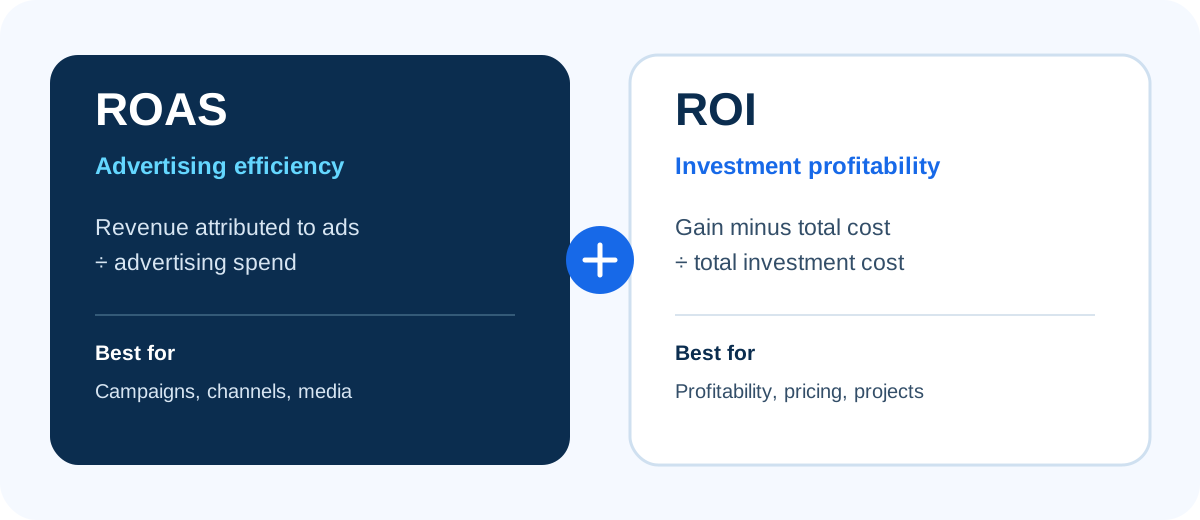
ROAS vs ROI at a glance
| Metric | What it measures | Basic formula | Best used for |
|---|---|---|---|
| ROAS | Revenue generated for each unit of advertising spend | Attributed revenue ÷ ad spend | Campaign, channel and media efficiency |
| ROI | Profit generated relative to the total investment | (Gain − total cost) ÷ total cost | Profitability and broader business decisions |
If you want to work with your own numbers, start with the ROAS calculator or the ROI calculator.
What does ROAS measure?
Return on ad spend measures the relationship between advertising revenue and advertising cost. A ROAS of 4.0 means the campaign generated four units of attributed revenue for every one unit spent on advertising.
Google Ads uses conversion value relative to cost when discussing return on ad spend and Target ROAS bidding. Its guidance also stresses that conversion values need to reflect meaningful business value for the metric to be useful. Google Ads explains conversion values and Target ROAS.
What does ROI measure?
Return on investment looks beyond media efficiency. It considers the gain from an investment against the total cost required to create that gain. Those costs may include advertising, product cost, software, fulfillment, agency fees, labor or other operating expenses.
Google Ads describes ROI as a measure based on net profit relative to costs, which is why ROI is usually the better metric when the decision is about profitability rather than advertising efficiency alone. See Google Ads guidance on calculating ROI.
ROAS formula
The basic ROAS formula is:
ROAS = Revenue attributed to advertising ÷ Advertising spend
For example, if you spend ₹100,000 on advertising and attribute ₹500,000 in revenue to that activity, your ROAS is 5.0, or 5x.
ROI formula
A common ROI formula is:
ROI = (Gain from investment − Total investment cost) ÷ Total investment cost × 100
If an initiative produces ₹500,000 in gain and the total cost is ₹400,000, the profit is ₹100,000. Dividing ₹100,000 by ₹400,000 produces an ROI of 25%.
The key difference between ROAS and ROI
ROAS isolates the advertising relationship. ROI expands the view to the wider economics of the decision. That difference matters because revenue is not the same as profit.
Imagine two campaigns with the same 5x ROAS. Campaign A sells a high-margin service with low delivery cost. Campaign B sells a low-margin product with expensive fulfillment. Their ROAS may look identical, but their ROI can be very different.
When should you use ROAS?
Use ROAS when you need to compare advertising efficiency across campaigns, channels, audiences or media plans. It is especially useful when you are deciding how much budget to allocate and where incremental advertising spend may work hardest.
For broader allocation work, the media planning calculator can help you test channel budgets and assumptions alongside campaign performance.
When should you use ROI?
Use ROI when the decision extends beyond advertising and you need to understand whether the full investment is worthwhile. ROI is useful for software purchases, business initiatives, pricing decisions, campaign profitability and projects with meaningful non-media costs.
Why marketers should use both
ROAS works well as an operating metric because teams can monitor it frequently and compare campaign efficiency. ROI works better as a business metric because it introduces profit and total cost.
A practical workflow is to use ROAS to diagnose advertising performance, then use ROI to confirm whether the wider commercial outcome makes sense. This prevents a strong platform metric from being mistaken for a strong business result.
Common mistakes to avoid
- Treating revenue as profit. A high ROAS does not automatically mean a campaign is profitable.
- Ignoring attribution quality. ROAS depends on the revenue you attribute to advertising, so weak tracking can distort the result.
- Comparing unlike businesses. A healthy ROAS varies with gross margin, repeat purchases, fulfillment cost and customer lifetime value.
- Using one metric for every decision. Campaign optimization and investment profitability are different questions.
A simple decision framework
- Use ROAS when the main question is, “How efficiently is advertising generating revenue?”
- Use ROI when the main question is, “Is this investment creating enough profit for the total cost?”
- Use both when advertising performance influences a wider budget, pricing or growth decision.
If you need to move from measurement into planning, explore MPPM Resources for practical templates and working materials, or review Professional Services when the decision needs a custom strategy or commercial model.
Frequently asked questions
Is ROAS the same as ROI?
No. ROAS compares attributed advertising revenue with advertising spend. ROI compares gain or profit with the broader cost of the investment.
Can ROAS be high while ROI is low?
Yes. High product costs, discounts, fulfillment expenses, agency fees or other operating costs can reduce ROI even when ROAS looks strong.
Which metric should I use for media optimization?
ROAS is usually more useful for campaign and channel optimization because it focuses directly on advertising efficiency. ROI becomes more important when you need to judge the commercial outcome after wider costs.
MPPM Guides are educational content. Products, prices, platform features and rules can change, so verify time-sensitive details with the relevant provider or primary source before acting.